
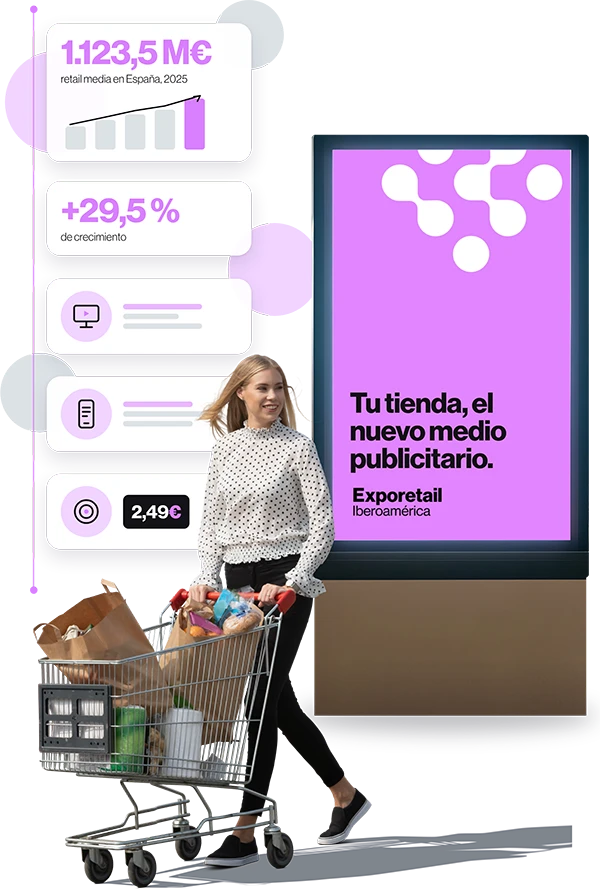
Stores are establishing themselves as new advertising spaces in a market that seeks to connect brands with consumers more effectively, make use of purchase data and measure the real impact of every campaign.
For years, point-of-sale advertising has been associated mainly with displays, promotional posters, gondola ends and product demonstrations. Today, that landscape is changing. Why?
- The digitalisation of stores
- The development of new technologies
- The value of commercial data
These factors are driving retail media, a model that allows retailers to turn their physical and digital spaces into advertising channels for brands.
The proposition is attractive for both sides:
- Retailers can generate new sources of revenue from their assets and the relationship they maintain with their customers
- Brands, for their part, find new opportunities to reach relevant audiences at a particularly important moment: when they are making purchasing decisions.
From shelves to a media network
Retail media has broadened the traditional concept of in-store advertising. Digital screens, audiovisual media, audio systems, electronic shelf labels and other connected solutions make it possible to run more dynamic campaigns adapted to the context of the store. On top of this comes the possibility of linking these formats to e-commerce platforms and retailers' apps. In this way, a campaign can combine ads on a website or app, advertising aimed at specific audiences and activations in the physical store itself.
This omnichannel vision is one of the keys to its evolution. Consumers do not necessarily distinguish between the channels of a brand or a retailer: they research on their phones, compare alternatives online and, in many cases, end up buying in a physical store. For advertisers, coordinating the different touchpoints makes it possible to build more coherent strategies along the purchase journey.
The omnichannel vision is one of the keys to the current evolution and rise of retail media
Reaching the consumer at the key moment
One of the main strengths of retail media is its proximity to the purchase. Unlike other advertising formats, which may influence a future decision, in-store communication can reach the consumer while they compare products, check prices or decide what to take home. This closeness also opens up new possibilities for segmentation. Purchase data and loyalty programmes can help retailers get to know their audiences better and brands design more relevant campaigns, always within the legal limits that apply to the processing of personal data.
The economic appeal of the model is linked to this ability to connect advertising and commercial activity. In Spain, the ‘Estudio de Inversión de Retail Media 2025’ (Retail Media Investment Study 2025) by Retail X Digital estimates that the market reached €1,123.5 million, growing 29.5% compared with the comparable 2024 base. The analysis includes different activation environments, both digital and physical, so the figure does not correspond exclusively to advertising inside stores.
The figure reflects the scale this activity is taking on and the interest in developing proprietary advertising networks within the distribution sector. It also points to a transformation in the relationship between retailers, brands and advertisers: the store is no longer just a sales channel and becomes, in addition, an asset capable of generating advertising value.
Measuring results beyond visibility
The growth of retail media nevertheless raises some challenges. Installing screens or expanding advertising inventory does not, on its own, guarantee that a campaign will be effective. To consolidate this model, operators need to define what they offer advertisers, understand the performance of their media and establish reliable measurement criteria.
The question is especially relevant when the same campaign combines physical stores, e-commerce and advertising in other channels. Brands need to distinguish between sales that occur during a promotional activity and those that can genuinely be attributed to its impact. They must also be able to compare results across advertising networks and understand which formats contribute best to their objectives.
Transparency, standardised metrics and data quality are therefore decisive factors for retail media to move towards a more professional model. In addition, advertising needs to be integrated naturally into the shopping experience, avoiding message overload and preserving the usefulness of commercial spaces for the consumer.
For retailers, the challenge is to balance the monetisation of their assets with the needs of their customers and of the brands they work with. For advertisers, it means evaluating retail media not as an isolated medium but as part of a strategy that must respond to specific objectives and deliver demonstrable results.
A new landscape
The evolution of retail media reflects a broader trend: the growing connection between commerce, advertising, technology and data. The physical store retains its central role in the consumer experience, but adds new capabilities that make it possible to measure, personalise and extend the reach of commercial actions.
The development of this market will depend on the sector's ability to take advantage of these opportunities without losing sight of essential issues such as customer experience, privacy, transparency and the measurement of impact. Technology opens up new possibilities, but it will be the strategy with which it is integrated into the business that determines its true value.
In this context, ExpoRetail Iberoamérica 2027 will be an opportunity to see how the strategies, technologies and business models transforming distribution and the shopping experience are evolving. The event will bring the retail ecosystem together at IFEMA Madrid on 9 and 10 June 2027, encouraging the exchange of knowledge and contact between the professionals who are defining the future of the sector.
More information at exporetail.net.