
Artificial intelligence (AI) is no longer a promise of the future for physical retail. It is starting to have a dramatic impact on how shops understand consumers, manage their operations and offer faster, more personalised experiences. But the great transformation is not about filling stores with technology; it is about using it to solve real needs without losing the human touch.
For years, much of the conversation about artificial intelligence applied to Retail was tied to e-commerce: product recommenders, dynamic pricing, chatbots and personalisation. Meanwhile, most purchases continued to take place among aisles, fitting rooms and tills.
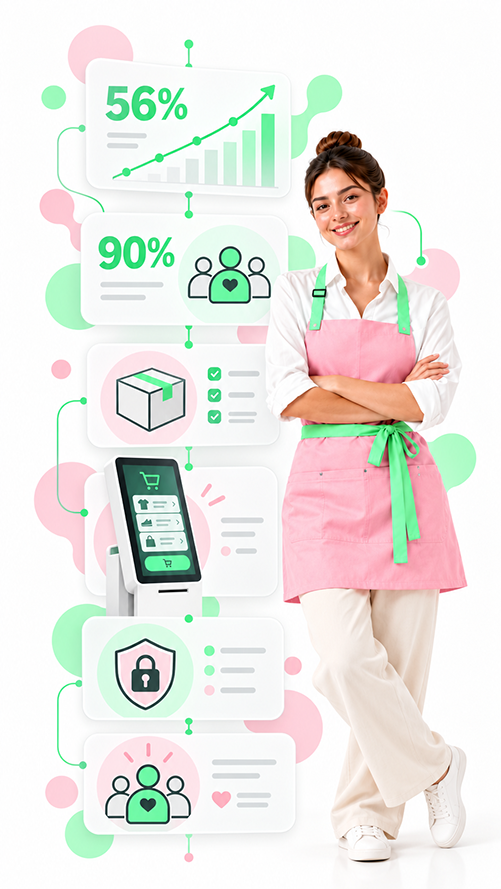
Now AI is beginning to change that scene too. And it does so in a way that, in many cases, consumers do not even notice. According to Deloitte's study ‘The Human and the Agent’, 56% of European consumers surveyed have already used artificial intelligence to shop at least once. The speed of adoption is particularly striking: AI took around 18 months to exceed 50% usage, compared with roughly five years for e-commerce and ten for the smartphone.
The question, therefore, is no longer whether artificial intelligence will reach shops, but what is really changing for the people who walk into them.
“Understanding” what happens inside the shop
One of the most important changes is also one of the least visible. Artificial intelligence, combined with computer vision, sensors, RFID and data analysis tools, makes it possible to know more precisely how customers behave inside a shop: where they move, where queues form, which areas see the most activity and how available certain products are.
The result may seem simple, but it has a direct impact on the experience: shorter queues, better availability and stores increasingly designed on the basis of data rather than intuition alone. So-called “invisible AI” is thus gaining ground: technology that works behind the scenes to remove friction without requiring consumers to interact with it directly. In this context, the real value of artificial intelligence may lie less in surprising the customer than in making certain things work better.
A smarter shop and a smarter purchase
For years, the most iconic image of artificial intelligence applied to physical retail was walking in, picking up products and walking out without going through a till. Amazon popularised this model with its Just Walk Out system. However, what happened next is especially interesting. In 2024, the company withdrew this technology from its Amazon Fresh supermarkets in the United States and bet on smart carts, which let shoppers check offers, keep track of what is in their basket and see how much they are saving as they go round the shop.
The experience offers a relevant lesson: consumers do not necessarily want to remove all interaction; they want to remove the interactions they consider unnecessary.
In Spain, companies such as Inditex are also moving towards payment models and in-store technology that aim to make the experience smoother. In this case, the company has rolled out a new tagging technology linked to its Assisted Checkout service. It is not strictly artificial intelligence, but it is an example of how technology can be built into the shop with a specific goal: making it easier to interact with the product and speeding up the purchase process.
The conclusion seems clear: the best technology is not necessarily the most spectacular, but the one that solves a real friction without taking away the consumer's information, autonomy or control.
The shop assistant does not disappear; they transform
Contrary to the image of a fully automated shop, one of the most relevant changes may well run in the opposite direction. Technology can give employees more information and better tools to serve customers: from checking stock available in other shops to accessing, when the consumer authorises it, information about their preferences, suggesting product combinations or taking payment anywhere in the store.
The opportunity lies in using AI to free employees from routine tasks and give them the context to make better decisions. According to data from Zebra's ‘Global Shopper Study’, 71% of shoppers consider the help they receive in shops insufficient, while 90% of employees believe technology tools improve customer service.
This connects with one of the great paradoxes of the new Retail: the more technology a shop adopts, the more important the human dimension can become. As Ángel Jareño, CEO of Uvesco and member of the organising committee of ExpoRetail Iberoamérica, puts it, “the more technology we bring in, the more human Retail has to be”. Technology can make commerce smarter and more efficient, but trust remains an essential element of the relationship with the consumer.
The AI that accompanies the consumer
The transformation does not come only from Retail chains. Consumers themselves are changing too. More and more people arrive at the shop after asking an artificial intelligence assistant, comparing products or looking for recommendations. According to Deloitte, among consumers who already use AI to shop, 57% use it to compare products. This brings a new player into the decision process: the consumer's personal AI assistant.
And here appears one of the potentially deepest changes for brands. For decades, companies have competed to capture consumers' attention and convince them to choose their product. In the new scenario, they will also have to make sure their products are considered relevant by the artificial intelligence systems that help consumers decide.
Laureano Turienzo, Chairman of ExpoRetail Iberoamérica, sums up this transformation by saying that we are at “Day 1” of a new Retail: “for the first time, some purchasing decisions are starting to be delegated to artificial intelligence systems capable of selecting products and services on the consumer's behalf”.
Personalisation yes, control no
There is, however, a red line: trust. Consumers value the possibility of receiving more relevant and personalised recommendations, but at the same time they are concerned about how their data is used. VML's study ‘The Future Shopper 2026’ finds that 58% of consumers double-check AI-generated product recommendations through other channels.
In the physical environment, the issue takes on a special dimension. It is one thing for a shop to know our buying habits and quite another for the consumer to feel they are being watched.
The Mercadona case is a particularly significant precedent in Spain. In 2021, the Spanish Data Protection Agency proposed a fine of €3.15 million on the company for the facial recognition system it had trialled in 48 supermarkets. The chain ended up paying €2.52 million and abandoned the system.
The future therefore seems to point towards ever greater use of aggregated data and technologies capable of analysing behaviour without needing to identify individuals.
Customer experience thus gains a new dimension: transparency. Explaining what is measured, what it is used for and what options the consumer has can be as important as the technology itself.
One transformation, two speeds
The adoption of artificial intelligence in shops will not be the same for everyone. Large operators such as Inditex are making significant investments to optimise their stores, integrate technology and increasingly connect their physical and digital operations. But a large part of Spain's retail fabric is made up of small businesses with less capacity to invest.
The figures confirm it. According to the latest INE data, 21.1% of Spanish companies with 10 or more employees used AI technologies in the first quarter of 2025, compared with 13.4% of companies with fewer than 10 employees. In the former, moreover, adoption had risen by 8.7 percentage points in just one year. In a sector such as Retail, where large operators coexist with a broad network of small businesses, this difference is especially relevant.
Perhaps for that reason, the key question will not only be who adopts AI first, but who manages to turn it into concrete results.
Online or physical: the end of the dichotomy
Everything suggests that the transformation of the physical shop will not be marked by a succession of great technology showcases, but by hundreds of small accumulated improvements: a queue that disappears before it grows, a size that is available when the customer needs it, an employee who can answer a question immediately or a consumer who receives a truly useful recommendation. It is, ultimately, a question of time, trust and connection.
And this transformation connects directly with one of the big debates raised by ExpoRetail Iberoamérica: the future of commerce can no longer be analysed through the old dichotomy between online and physical. Consumers do not distinguish between channels; they expect consistent, seamless and personalised experiences.
Artificial intelligence can contribute decisively to achieving this, but it is not an end in itself. Technology will improve efficiency, personalise experiences and optimise processes, but it can also widen the gap between large operators and small shops if it is not managed properly.
The Fantastic 4
For that reason, the pillars for any Retail business that wants to move forward in this area could be summed up in four:
- First the customer, then the technology. AI must respond to specific needs and improve the shopping experience.
- Use AI to empower people, not simply to replace them. Human service remains one of the physical shop's great assets.
- Design experiences for different consumers. Some will want self-service and others will prefer to talk to a professional.
- Make privacy and transparency part of the experience. Trust will matter more and more as shops' technological capability grows.
The physical shop is not going to disappear with artificial intelligence; it is simply going to change its role. And perhaps the great opportunity for Retail is not to make shops look more technological, but to make them better able to understand the consumer and serve them better.